
Want to Have Capitalize Explained Instead of Reading the Instructions?
Watch an in-depth walkthrough of not only the rulebook, but also key components to be conscious of as you play Capitalize.
Highly recommended if you want to get up and playing right away!

How to Play Capitalize...
STILL NOT SURE?
Frequently Asked Questions
We understand different players call for different playstyles which is why we've broken down the most controversial guidelines here!
Can you buy and sell the same asset in the same turn?
This is a very popular strategy! No, you cannot buy and sell the same specific asset during the same turn; however, you can buy and sell the same asset class. For example, you cannot purchase a piece of land and sell that newly bought land in the same turn. You can; however, purchase a piece of land and sell a different (already existing) piece of land that you own.
When's your next play turn if you go to school right after your current turn (or during your turn)?
No matter when you go to school, you must skip 1 of your turns regardless of if you go to school during one of your turns or during one of your opponent's turns.
In the event that two of the same industries are rolled, do you get double the salaries?
Absolutely! That's the fun part about the game. For example, if two hammers are rolled... and if you're in the Building industry, you would receive twice your salary since you were working overtime on that roll!
Do I get the investment income from the pieces I build on top of during the game? AND does it count towards my net worth?
This is tricky! If there is any part of an asset/triangle showing on the board, then you DO count it towards investment income at the start of each turn as well as counting towards your net worth. For example, you have a 3 Urban triangles on top of a Suburban triangle... You technically still have a bit of the Suburban showing so you DO get to count it. However, once you place that 4th Urban triangle... That Suburban triangle will be fully covered, meaning you CANNOT count it towards investment income or your net worth.
If I sell an Urban triangle, do I get to keep the Suburban triangle that's underneath?
It depends. Similarly to how you count the investment income and net worth... If there is any part of an asset/triangle showing on the board PRIOR to the sale, then you DO get to keep the piece underneath. For example, you have a 3 Urban triangles on top of a Suburban triangle... You technically still have a bit of the Suburban showing so you DO get to keep that entire Suburban triangle in the event that you sell one (or all) of your Urban triangles. In the event that you have 4 Urban triangles on a single Suburban triangle... You do NOT get to keep that Suburban triangle at all.
Best practice is to completely remove the triangle pieces underneath once it's completely covered. That way you stay organized on what you get to keep and what you don't get to keep in the event of selling assets.
Have other questions? Shoot us an email!
Download Capitalize Instructions
Download the most up to date and current PDF instructions for Capitalize.
(Instruction booklet is included in all game sets.)
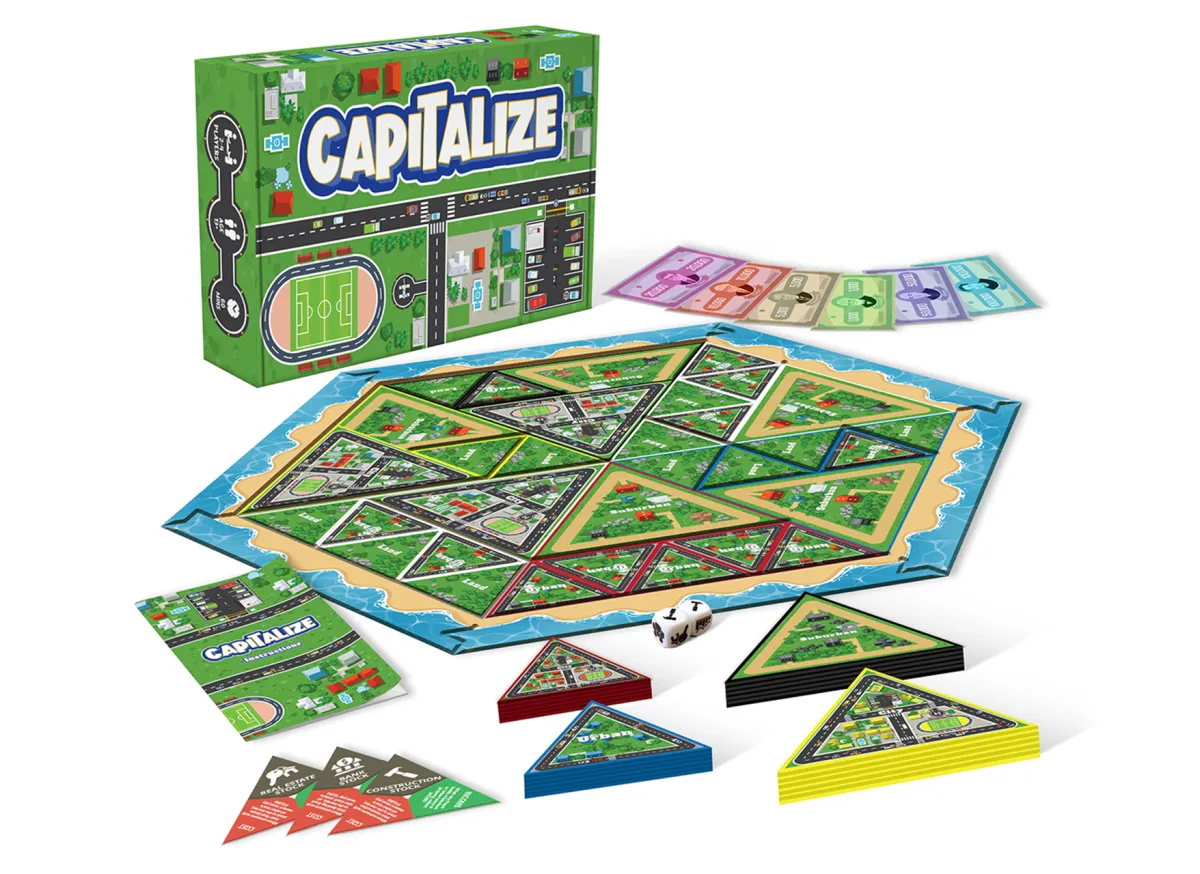
The Millionaire-Maker Board Game
Capitalize was designed to prove to everyone that whether it's in the game of Capitalize or in real life... playing to your strengths is ultimately how to come out ahead.
It's all about how well you take advantage of what makes you... YOU!
Don't Miss Out
As soon as Capitalize is in stock, we'll let you know right away. No junk mail coming from us!
Privacy Policy | Terms & Conditions
© 2026 Capitalize Board Game - 2RICH GAMES LLC. All rights reserved.